
Biography of Marie curie
INTRODUCTION
Marie Curie was a pioneering scientist whose groundbreaking work in physics and chemistry changed the world’s understanding of radioactivity. She is widely regarded as one of the most influential scientists in history and remains an inspiration for generations, especially for women in science. Her dedication, intelligence, and perseverance led to discoveries that continue to impact medicine and technology today.
Early Life and Background
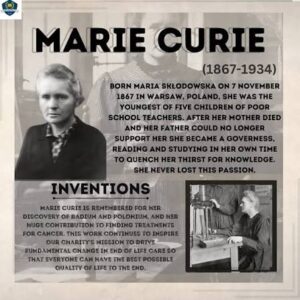
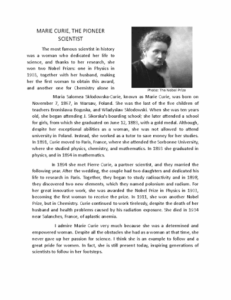
Marie Curie was born as Maria Skłodowska on November 7, 1867, in Warsaw, Poland. At the time, Poland was under Russian control, and opportunities for education, especially for women, were limited. Despite these challenges, Marie showed exceptional intelligence and a strong desire to learn from a young age.
She grew up in a family that valued education. Her father was a teacher of mathematics and physics, which helped spark her interest in science. However, her early life was not without hardship. She lost her mother at a young age and faced financial difficulties, but these challenges only strengthened her determination to succeed.
Education
Because women were not allowed to attend university in Poland at the time, Marie continued her education through informal means. She was part of a secret educational group known as the “Flying University,” where students could study despite restrictions imposed by authorities.
Later, she moved to Paris, France, to pursue higher education. She enrolled at the University of Paris (Sorbonne), where she studied physics and mathematics. Life in Paris was not easy for her—she lived in a small room and often struggled financially—but her dedication to her studies never wavered.
Marie graduated at the top of her class in physics and later earned a second degree in mathematics. Her academic excellence quickly set her apart as a brilliant scientist.
Meeting Pierre Curie
While working on her research in Paris, Marie met Pierre Curie, a respected physicist. The two shared a deep passion for science, and their partnership soon became both professional and personal. They got married in 1895.
Together, Marie and Pierre began studying a mysterious phenomenon discovered by Henri Becquerel, which involved invisible rays emitted by uranium. This research would later become known as radioactivity, a term Marie herself coined.
Scientific Discoveries
Marie Curie’s work led to the discovery of two new elements: polonium (named after her homeland, Poland) and radium. These discoveries were groundbreaking and opened new areas of research in science.
Her research showed that radioactivity was not dependent on chemical reactions but came from within the atom itself. This idea was revolutionary and changed the way scientists understood matter.
Marie’s work required intense effort. She spent years processing large amounts of mineral ore to isolate tiny quantities of radioactive elements. Despite the physical demands and risks, she remained committed to her research.
 Nobel Prizes and Achievements
Marie Curie made history in several ways:
- In 1903, she shared the Nobel Prize in Physics with Pierre Curie and Henri Becquerel for their work on radioactivity. She became the first woman to win a Nobel Prize.
- In 1911, she won a second Nobel Prize in Chemistry for her discovery of polonium and radium and her research on radioactivity.
- She remains the only person to win Nobel Prizes in two different scientific fields.
Challenges and Personal Struggles
Marie Curie faced many challenges throughout her life. As a woman in science during her time, she often encountered discrimination and limited opportunities. Despite her achievements, she was not always given equal recognition.
In 1906, her husband Pierre died in a tragic accident. His death was a devastating blow, but Marie continued their scientific work. She later became the first female professor at the University of Paris, taking over Pierre’s teaching position.
Her work with radioactive materials also came at a cost. At the time, the dangers of radiation were not fully understood, and she was exposed to high levels without protection.
Contributions During World War I
, Marie Curie applied her scientific knowledge to help save lives. She developed mobile X-ray units, often called “Little Curies,” which were used to examine injured soldiers on the battlefield.
She personally trained technicians and even drove the units herself to assist medical teams. Her efforts greatly improved the treatment of wounded soldiers and demonstrated the practical importance of scientific research.
Later Life and Death
Marie Curie continued her research and scientific work throughout her life. She established research institutes and mentored young scientists, contributing to the growth of scientific knowledge.
Unfortunately, her long-term exposure to radiation eventually affected her health. She died on July 4, 1934, from a blood-related illness linked to radiation exposure.
Despite her passing, her legacy lives on through her discoveries and the many scientists she inspired.
Legacy and Impact
Marie Curie’s contributions to science are immeasurable. Her work laid the foundation for advancements in:
- Medical treatments, including cancer therapy
- Nuclear physics
- Scientific research on atomic structure
- She also broke barriers for women in science, proving that determination and talent can overcome societal limitations.
Today, her name is honored in many ways:
The unit of radioactivity, the curie (Ci), was named after her
- Research institutions and universities bear her name
- She is remembered as a symbol of dedication and scientific excellence
Conclusion
Marie Curie’s life story is one of courage, intelligence, and perseverance. From her early struggles in Poland to her groundbreaking discoveries in Paris, she remained committed to advancing human knowledge.
Her achievements continue to influence science and medicine, and her legacy serves as an inspiration to people all over the world. Marie Curie is not only remembered as a brilliant scientist but also as a trailblazer who changed the course of history.


Be the first to comment