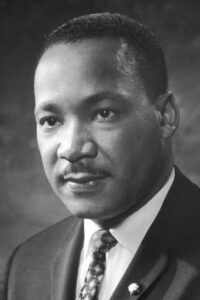
INTRODUCTION
Martin Luther King Jr. was a prominent American civil rights leader, minister, and activist who played a pivotal role in the fight against racial segregation and injustice in the United States. Renowned for his commitment to nonviolent resistance and equality, King became a global symbol of peace, justice, and human rights. His leadership and vision helped transform American society and inspired movements for civil rights around the world.
Early Life and Background
Martin Luther King Jr. was born on January 15, 1929, in Atlanta, Georgia, United States. He was born into a family deeply rooted in the Christian faith and community leadership. His father, Martin Luther King Sr., was a respected Baptist minister, and his mother, Alberta Williams King, was a teacher and church organist.
Growing up in the segregated American South, King experienced racial discrimination from a young age. These early experiences shaped his understanding of injustice and inspired his lifelong commitment to equality and civil rights. Despite the challenges of segregation, he excelled academically and showed early signs of leadership and intelligence.
Education
Martin Luther King Jr. was an exceptional student. He skipped grades in school and entered Morehouse College in Atlanta at the age of 15. At Morehouse, he studied sociology and was influenced by the college president, Dr. Benjamin Mays, who encouraged him to pursue a life dedicated to social justice.
After graduating in 1948, King attended Crozer Theological Seminary in Pennsylvania, where he earned a degree in divinity. During his time there, he developed a strong interest in theology, ethics, and social justice, and he was influenced by the teachings of Mahatma Gandhi on nonviolent resistance.
He later pursued doctoral studies at Boston University, where he earned a Ph.D. in Systematic Theology in 1955. His academic training helped shape his philosophical and moral approach to activism.
Early Career and Ministry
In 1954, Martin Luther King Jr. became the pastor of the Dexter Avenue Baptist Church in Montgomery, Alabama. His role as a minister allowed him to connect with the community and provided a platform for his emerging leadership in the civil rights movement.
King believed strongly in the power of faith, love, and nonviolence as tools for social change. His preaching emphasized equality, justice, and compassion, values that would define his leadership throughout his life.
Montgomery Bus Boycott
Martin Luther King Jr. rose to national prominence during the Montgomery Bus Boycott of 1955–1956. The boycott began after Rosa Parks, an African American woman, was arrested for refusing to give up her seat to a white passenger on a segregated bus.
King was chosen as the leader of the boycott, which involved African Americans refusing to use the city’s bus system for over a year. His leadership, eloquence, and commitment to nonviolence helped sustain the movement despite challenges and threats.
The boycott ended with a Supreme Court decision declaring segregation on public buses unconstitutional. This victory marked a major milestone in the civil rights movement and established King as a national leader.
Leadership in the Civil Rights Movement
Following the success of the Montgomery Bus Boycott, King co-founded the Southern Christian Leadership Conference (SCLC) in 1957. The organization aimed to coordinate nonviolent protests and campaigns for civil rights across the United States.
King led numerous campaigns to end racial segregation and discrimination, including protests in cities such as Birmingham, Alabama, where activists faced harsh opposition. Despite arrests and intimidation, King remained committed to peaceful resistance.
His leadership helped bring national attention to the injustices faced by African Americans and mobilized widespread support for civil rights reforms.
“I Have a Dream” Speech
One of the most defining moments of Martin Luther King Jr.’s life was the March on Washington for Jobs and Freedom in 1963. During this historic event, King delivered his famous “I Have a Dream” speech in front of the Lincoln Memorial.
In his speech, King expressed his vision of a future where people would be judged not by the color of their skin but by the content of their character. His powerful words resonated with millions of people and became a defining symbol of the civil rights movement.
The speech is widely regarded as one of the greatest speeches in history and continues to inspire people around the world.
Awards and Recognition
Martin Luther King Jr.’s contributions to civil rights and social justice earned him numerous awards and honors. In 1964, he was awarded the Nobel Peace Prize, becoming one of the youngest recipients at the time.
He was recognized globally for his commitment to nonviolence, equality, and human rights. His work played a significant role in the passage of key legislation, including:
- The Civil Rights Act of 1964
- The Voting Rights Act of 1965
- These laws helped end segregation and protect the rights of African Americans in the United States.
Personal Life
Martin Luther King Jr. married Coretta Scott in 1953, and the couple had four children. Coretta Scott King was also an activist and played a significant role in supporting her husband’s work and continuing his legacy after his passing.
Despite the demands of his leadership, King remained devoted to his family and faith. He faced numerous personal challenges, including threats to his safety, but remained committed to his mission of achieving justice through peaceful means.
Challenges and Opposition
Throughout his life, Martin Luther King Jr. faced significant opposition from individuals and institutions that resisted change. He was arrested multiple times, and his home was targeted during protests.
Despite these challenges, King remained steadfast in his commitment to nonviolence. He believed that love and peaceful resistance were the most powerful tools for overcoming injustice.
His courage and resilience inspired millions of people to join the civil rights movement and advocate for equality.
Later Years and Advocacy
In his later years, King expanded his focus beyond civil rights to address issues such as poverty, economic inequality, and opposition to war. He organized the Poor People’s Campaign, which aimed to address economic injustice and improve living conditions for disadvantaged communities.
He also spoke out against the Vietnam War, advocating for peace and global cooperation. His broader vision emphasized justice, equality, and dignity for all people, regardless of race or background.
Death and Legacy
Martin Luther King Jr. was assassinated on April 4, 1968, in Memphis, Tennessee, at the age of 39. His death was a profound loss to the world, but his legacy continues to inspire movements for justice and equality.
Today, Martin Luther King Jr. is remembered as one of the greatest leaders in history. His legacy includes:
- Advancing civil rights and ending segregation in the United States
- Promoting nonviolent resistance as a powerful tool for social change
- Inspiring global movements for human rights and equality
- Establishment of Martin Luther King Jr. Day, a national holiday in the United States

Be the first to comment