INTRODUCTION
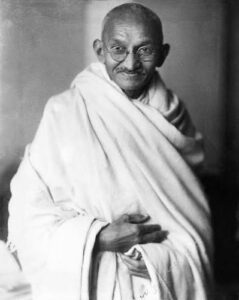
Mahatma Gandhi, born Mohandas Karamchand Gandhi, was a prominent Indian leader, lawyer, and activist who played a central role in India’s struggle for independence from British colonial rule. Widely known as the “Father of the Nation” in India, Gandhi is celebrated for his philosophy of nonviolence and peaceful resistance. His methods and ideals have influenced civil rights movements across the world, making him one of the most respected figures in global history.
Early Life and Background
Mahatma Gandhi was born on October 2, 1869, in Porbandar, a coastal town in present-day Gujarat, India. He was born into a Hindu family of the Vaishya (merchant) caste. His father, Karamchand Gandhi, served as a chief minister in the local government, while his mother, Putlibai, was deeply religious and influenced Gandhi’s moral and spiritual upbringing.
As a child, Gandhi was shy and reserved but known for his honesty and strong sense of duty. His upbringing emphasized values such as truthfulness, simplicity, and compassion, which later became central to his philosophy and leadership.
Education
Gandhi received his early education in India before traveling to London in 1888 to study law. He enrolled at the Inner Temple, one of the four Inns of Court, where he trained to become a barrister.
During his time in London, Gandhi was exposed to different cultures, religions, and philosophical ideas. He studied various religious texts, including the Bhagavad Gita and the Bible, which influenced his thinking about morality, justice, and nonviolence.
After completing his studies, he returned to India in 1891 and began practicing law. However, his early legal career was not very successful, prompting him to seek opportunities elsewhere.
 Experience in South Africa
A turning point in Gandhi’s life came in 1893, when he traveled to South Africa to work as a lawyer. There, he experienced racial discrimination firsthand, including being removed from a train despite having a valid ticket.
These experiences deeply affected Gandhi and motivated him to fight against injustice. During his 21 years in South Africa, he developed his philosophy of Satyagraha, which means “truth-force” or “soul-force.” This approach emphasized nonviolent resistance and civil disobedience as tools for achieving social and political change.
Gandhi organized peaceful protests and campaigns to challenge discriminatory laws against Indians in South Africa. His success in these efforts established him as a leader and laid the foundation for his future role in India’s independence movement.
Return to India and Leadership
Gandhi returned to India in 1915, where he became involved in the struggle for independence from British rule. He quickly emerged as a leader of the Indian National Congress, advocating for self-rule and social reforms.
Gandhi’s leadership style was unique. He emphasized nonviolence, simplicity, and mass participation. He encouraged ordinary people, including farmers, workers, and women, to join the movement for independence.
Major Campaigns and Movements
Gandhi led several significant campaigns that challenged British authority and mobilized millions of Indians:
- Champaran Movement (1917): Gandhi supported farmers protesting against unfair treatment by British plantation owners.
- Non-Cooperation Movement (1920–1922): He urged Indians to boycott British goods, institutions, and titles.
- Salt March (1930): One of his most famous protests, Gandhi led a 240-mile march to the sea to produce salt in defiance of British laws.
- Quit India Movement (1942): Gandhi called for the immediate end of British rule in India.
These movements demonstrated the power of nonviolent resistance and brought international attention to India’s struggle for independence.
Philosophy of Nonviolence
Gandhi’s philosophy of Ahimsa (nonviolence) and Satyagraha formed the core of his approach to activism. He believed that true change could be achieved through peaceful means, moral courage, and adherence to truth.
His principles included:
- Nonviolent resistance to injustice
- Respect for all individuals
- Self-discipline and simplicity
Commitment to truth and moral integrity
Gandhi’s philosophy influenced global leaders such as Martin Luther King Jr. and Nelson Mandela, who adopted similar methods in their struggles for civil rights and freedom.
Personal Life
Gandhi married Kasturba Gandhi at a young age, as was customary at the time. The couple had children and shared a long partnership marked by mutual support and dedication to social causes.
Gandhi adopted a simple lifestyle, often wearing traditional Indian clothing and living modestly. He believed in self-reliance and promoted the use of locally made goods, including hand-spun cloth known as khadi.
His personal life reflected his commitment to his principles, and he often practiced what he preached in his daily actions.
Challenges and Opposition
Gandhi faced numerous challenges throughout his life, including arrests, imprisonment, and opposition from both British authorities and some Indian groups.
Despite these obstacles, he remained committed to his principles of nonviolence and truth. His ability to endure hardship and maintain his beliefs earned him widespread respect and admiration.
India’s Independence
India gained independence from British rule on August 15, 1947. While Gandhi’s efforts were instrumental in achieving this milestone, the period was also marked by the partition of India and Pakistan, which led to widespread communal tensions.
Gandhi worked tirelessly to promote peace and unity during this time, advocating for harmony between different religious and ethnic groups.
Death and Legacy
Mahatma Gandhi was assassinated on January 30, 1948, in New Delhi, India, by a nationalist who opposed his views on religious tolerance. His death was a significant loss to India and the world.
Gandhi’s legacy is profound and enduring. He is remembered as a champion of peace, justice, and human rights. His influence extends beyond India, inspiring movements for freedom and equality worldwide.
Global Influence and Recognition
Mahatma Gandhi’s ideas have had a lasting impact on global history. His methods of nonviolent resistance have been adopted by leaders and movements around the world.
His legacy includes:
- Inspiring civil rights movements globally
- Promoting nonviolence as a tool for social change
- Encouraging self-reliance and ethical living
- Advocating for equality and justice
- In recognition of his contributions, his birthday, October 2, is celebrated as the International Day of Non-Violence by the United Nations.
Conclusion
Mahatma Gandhi was a visionary leader whose commitment to nonviolence and truth transformed the course of history. From his early life in India to his leadership in the struggle for independence, his journey reflects courage, resilience, and moral strength.
Through his philosophy and actions, Gandhi demonstrated that peaceful resistance can bring about meaningful change. His legacy continues to inspire individuals and movements around the world, making him one of the most influential figures in history.

Be the first to comment