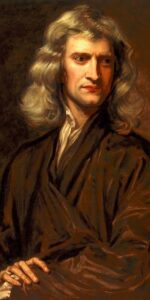
INTRODUCTION
Sir Isaac Newton was one of the most influential scientists in history, widely regarded as a key figure in the Scientific Revolution. His groundbreaking work in mathematics, physics, and astronomy laid the foundation for modern science. Newton is best known for formulating the laws of motion and universal gravitation, as well as for his contributions to calculus and optics. His discoveries transformed humanity’s understanding of the natural world and continue to shape scientific thought today.
Early Life and Background
Isaac Newton was born on January 4, 1643 (December 25, 1642, according to the Julian calendar) in Woolsthorpe, Lincolnshire, England. He was born prematurely and was not expected to survive, but he grew into a curious and intelligent child.
Newton’s father, also named Isaac Newton, died before he was born. His mother, Hannah Ayscough, remarried when he was young, leaving him in the care of his grandmother. This early separation had a lasting emotional impact on Newton, who grew up to be a reserved and introspective individual.
As a child, Newton showed a strong interest in building mechanical devices and observing the natural world. He created models, conducted simple experiments, and demonstrated an early aptitude for scientific thinking.
Education
Newton attended The King’s School in Grantham, where he excelled academically, particularly in mathematics and science. He later gained admission to Trinity College, Cambridge, in 1661.
At Cambridge, Newton studied a range of subjects, including mathematics, physics, and philosophy. He was influenced by the works of earlier scientists such as Galileo Galilei, Johannes Kepler, and René Descartes.
During this period, Newton began to develop his own ideas about mathematics and natural philosophy, laying the groundwork for his future discoveries.
The Plague Years and Early Discoveries
In 1665, the Great Plague forced Cambridge University to close, and Newton returned home to Woolsthorpe. During this time, often referred to as his “year of wonders,” he made some of his most important discoveries.
While working independently, Newton developed:
- The foundations of calculus, a new branch of mathematics
- Early ideas about gravity and the motion of objects
- Experiments in optics, including the study of light and color
- It was during this time that the famous story of the falling apple is said to have inspired his thinking about gravity. While the story is often simplified, it reflects his deep curiosity about why objects fall toward the Earth.
Laws of Motion
One of Newton’s most significant contributions to science is his formulation of the three laws of motion, which describe how objects move:
First Law (Law of Inertia): An object remains at rest or in uniform motion unless acted upon by an external force.
Second Law: The force acting on an object is equal to its mass multiplied by its acceleration (F = ma).
Third Law: For every action, there is an equal and opposite reaction.
These laws provided a framework for understanding motion and are still fundamental to physics and engineering today.
Law of Universal Gravitation
Newton’s law of universal gravitation explained that every object in the universe attracts every other object with a force proportional to their masses and inversely proportional to the square of the distance between them.
This discovery was revolutionary because it showed that the same force governing falling objects on Earth also controlled the motion of planets and celestial bodies. It unified terrestrial and celestial mechanics under a single principle.
Principia Mathematica
In 1687, Newton published his most famous work, Philosophiæ Naturalis Principia Mathematica (commonly known as the Principia). This book is considered one of the most important scientific works ever written.
In the Principia, Newton presented his laws of motion and universal gravitation, providing a mathematical description of the physical world. The book laid the foundation for classical mechanics and influenced scientific thought for centuries.
Contributions to Optics
Newton made significant contributions to the study of light and optics. He conducted experiments with prisms and demonstrated that white light is composed of a spectrum of colors.
He also developed the reflecting telescope, which used mirrors instead of lenses to produce clearer images. This invention improved the quality of astronomical observations and is still used in modern telescopes.
Mathematical Achievements
In addition to his work in physics, Newton made major contributions to mathematics. He is credited with the development of calculus, although this discovery was made independently by Gottfried Wilhelm Leibniz as well.
Newton’s work in mathematics provided essential tools for analyzing motion, change, and physical systems. His methods continue to be fundamental in science, engineering, and economics.
Later Career and Public Service
Newton held several important positions during his lifetime. He became a professor at Cambridge and later served as the President of the Royal Society, one of the leading scientific institutions in England.
He was also appointed Warden and later Master of the Royal Mint, where he worked to reform England’s currency system and combat counterfeiting.
In recognition of his contributions, Newton was knighted in 1705 by Queen Anne, becoming Sir Isaac Newton.
Personal Life
Isaac Newton was known for his intense focus and dedication to his work. He never married and lived a relatively private life. He had few close relationships and was often described as solitary and deeply absorbed in his studies.
Newton was also interested in theology and alchemy, spending significant time studying religious texts and philosophical questions about the nature of the universe.
Challenges and Controversies
Newton’s career was not without challenges. He was involved in disputes with other scientists, most notably with Robert Hooke and Gottfried Wilhelm Leibniz.
The dispute with Leibniz over the invention of calculus became one of the most famous controversies in scientific history. Despite these conflicts, Newton’s contributions remained widely recognized and respected.
Death and Legacy
Isaac Newton passed away on March 31, 1727, in London, England, at the age of 84. He was buried in Westminster Abbey, an honor reserved for some of the most distinguished individuals in British history.
Newton’s legacy is immense. His work laid the foundation for classical physics and influenced generations of scientists, including Albert Einstein.
Impact on Science and Society
Newton’s contributions have had a lasting impact on science and society. His laws of motion and gravitation are still used in fields such as engineering, astronomy, and space exploration.
His legacy includes:
- Establishing the principles of classical mechanics
- Advancing the study of mathematics and calculus
- Revolutionizing the understanding of light and optics
- Inspiring future scientific discoveries and innovations
Conclusion
Sir Isaac Newton was a visionary scientist whose discoveries transformed our understanding of the universe. From his early curiosity and independent discoveries to his groundbreaking work in physics and mathematics, his life reflects intellectual brilliance and dedication.
His contributions continue to shape modern science, making him one of the most influential figures in history. Newton’s work not only explained the natural world but also paved the way for future advancements, ensuring that his legacy will endure for generations.


Be the first to comment