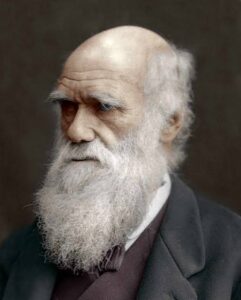
Charles Darwin (1809–1882) was an English naturalist whose groundbreaking theory of evolution by natural selection, published in On the Origin of Species (1859), fundamentally changed biology. His 1831–1836 voyage on the HMS Beagle provided the evidence for his theory, positing that species evolved from common ancestors through environmental adaptation.
Early Life and Education
Birth: Born on February 12, 1809, in Shrewsbury, Shropshire, England, into a wealthy, intellectual family.
Family: Son of Robert Darwin, a doctor, and Susannah Wedgwood; grandson of Erasmus Darwin, a renowned naturalist.
Education: Studied medicine at Edinburgh University but found it distressing; later studied theology at Christ’s College, Cambridge, where his passion for botany and natural history flourished.
The HMS Beagle Voyage (1831–1836)
Role: Recommended by professor J.S. Henslow as a naturalist for a five-year survey voyage around the world.
Key Observations: Studied varied flora, fauna, and geology in South America, the Galápagos Islands, and beyond.
Inspiration: Noted differences in species (like mockingbirds and tortoises) between islands, leading him to doubt the stability of species.
National Geographic Society Scientific Career and Theory
Development: After returning in 1836, he spent years analyzing his findings and developing his theory.
Natural Selection: Proposed that, similar to selective breeding, organisms with traits better suited to their environment are more likely to survive and reproduce.
Publication: Published On the Origin of Species in 1859, causing significant controversy by contradicting established religious views.
Other Works: Later published The Descent of Man (1871), applying his theories to human evolution, and works on botany and earthworms.
Personal Life and Legacy
Marriage: Married his cousin Emma Wedgwood in 1839; they had 10 children, seven of whom survived to adulthood.
Health: Suffered from chronic, debilitating health issues following his voyage, believed to be a tropical infection or, as some argue, a hereditary condition.
Death: Died on April 19, 1882, in Kent, England, and was buried in Westminster Abbey.
Darwin’s work remains the foundation of modern evolutionary studies.
Be the first to comment