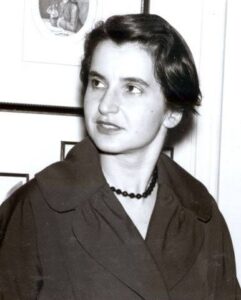
Rosalind Franklin (1920–1958) was a British chemist and X-ray crystallographer whose pioneering work was fundamental to understanding the molecular structures of DNA, RNA, viruses, and coal. She is best known for capturing “Photo 51,” a high-resolution X-ray image that provided key evidence for the double-helix structure of DNA, though her contributions were long underappreciated.
Early Life and Education
Birth: Born on July 25, 1920, in London to a prominent Anglo-Jewish family, she demonstrated an early, keen aptitude for science.
Education: Educated at St. Paul’s Girls’ School and later Newnham College, Cambridge, where she studied physical chemistry.
National Institutes of Health (NIH) | (.gov)
National Institutes of Health (NIH)
Scientific Career
War Work: During WWII, she contributed to research on the physical chemistry of coal and carbon for the British Coal Utilisation Research Association.
Paris (1947–1950): She perfected X-ray diffraction techniques at the Laboratoire Central des Services Chimiques de l’Etat in Paris.
DNA Research: Joining King’s College London in 1951, she applied her expertise to DNA, producing images that showed two forms of DNA.
Photo 51: Her meticulous work resulted in Photo 51 (1952), a clear X-ray diffraction image of the B-form of DNA, which directly influenced James Watson and Francis Crick in modeling the double helix.
Virus Research: Later at Birkbeck College, she led groundbreaking studies on the tobacco mosaic virus (TMV) and poliovirus, establishing foundations for structural virology.
Legacy and Recognition
Controversy: Franklin’s data, specifically Photo 51, was shared with competitors without her knowledge.
Death: She died of ovarian cancer in 1958 at the age of 37.
Posthumous Recognition: While Watson, Crick, and Wilkins received the Nobel Prize in 1962, the Nobel committee does not award prizes posthumously. She is now widely recognized as a “forgotten heroine” of science.
Be the first to comment