INTRODUCTION
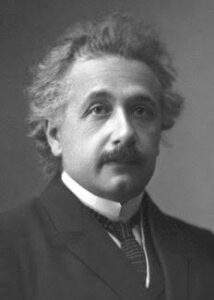
Albert Einstein is widely regarded as one of the greatest scientists in human history. Known for his groundbreaking contributions to physics, particularly the theory of relativity, Einstein transformed the way we understand space, time, energy, and the universe. Beyond his scientific achievements, he was also a philosopher, humanitarian, and global icon whose ideas continue to influence modern science and society.
Early Life and Background
Albert Einstein was born on March 14, 1879, in Ulm, in the Kingdom of Württemberg, part of the German Empire. He was born into a secular Jewish family. His father, Hermann Einstein, was an engineer and businessman, while his mother, Pauline Koch, was known for her love of music, which she passed on to her son.
Shortly after his birth, Einstein’s family moved to Munich, where his father and uncle started an electrical equipment company. As a child, Einstein was curious and thoughtful, though he was considered quiet and somewhat reserved. Contrary to popular myths, he did not fail in school, but he often questioned traditional teaching methods and preferred independent thinking.
One of the defining moments of his childhood was when he was given a compass. He became fascinated by the invisible forces that caused the needle to move, sparking a lifelong interest in science and the mysteries of nature.
Education
Einstein began his formal education in Munich, attending a Catholic elementary school and later the Luitpold Gymnasium. However, he struggled with the rigid and authoritarian style of teaching, which did not align with his curiosity-driven approach to learning.
At the age of 15, his family moved to Italy, and Einstein later continued his education in Switzerland. He enrolled at the Swiss Federal Polytechnic in Zurich (ETH Zurich), where he studied physics and mathematics. He graduated in 1900, although he initially struggled to secure an academic job.
Despite these early challenges, Einstein’s passion for physics never wavered. He continued to study independently and develop his ideas while working outside the academic world.
Early Career and the Patent Office
After graduation, Einstein found it difficult to obtain a teaching position. In 1902, he secured a job as a technical assistant at the Swiss Patent Office in Bern. While this job was not directly related to academic research, it provided him with financial stability and the time to think deeply about scientific problems.
During his time at the patent office, Einstein worked on evaluating patent applications related to electrical devices. This experience sharpened his analytical skills and exposed him to innovative technologies, which influenced his thinking about physics.
The Annus Mirabilis (Miracle Year) – 1905
In 1905, often referred to as Einstein’s “Annus Mirabilis” (Miracle Year), he published four groundbreaking scientific papers that revolutionized physics. These papers addressed fundamental questions about light, motion, and energy.
His key contributions in 1905 include:
- Photoelectric Effect: Einstein explained how light can behave as particles (photons), laying the foundation for quantum theory.
- Brownian Motion: He provided evidence for the existence of atoms by explaining the random movement of particles in a fluid.
- Special Theory of Relativity: This theory introduced the idea that time and space are relative and interconnected.
- Mass-Energy Equivalence: Expressed in the famous equation E = mc², showing that mass and energy are interchangeable.
These discoveries established Einstein as one of the leading scientists of his time.
Theory of Relativity
Einstein continued his work on relativity, and in 1915, he introduced the General Theory of Relativity, which expanded on his earlier ideas. This theory described gravity not as a force but as a curvature of space and time caused by mass and energy.
General relativity provided new insights into the structure of the universe and predicted phenomena such as:
- The bending of light by gravity
- The expansion of the universe
- The existence of black holes
In 1919, observations of a solar eclipse confirmed Einstein’s predictions, making him an international celebrity.
Awards and Recognition
Albert Einstein received numerous awards and honors for his contributions to science. In 1921, he was awarded the Nobel Prize in Physics for his explanation of the photoelectric effect, rather than for relativity.
His work laid the foundation for many modern technologies, including:
- Solar panels
- Nuclear energy
- GPS systems (which rely on relativity)
Einstein’s name became synonymous with genius, and he remains one of the most recognized figures in scientific history.
Personal Life
Einstein married Mileva Marić, a fellow student at ETH Zurich, in 1903. The couple had two sons, Hans Albert and Eduard. However, their marriage ended in divorce in 1919.
Later that same year, Einstein married his cousin, Elsa Einstein, who supported him throughout his career until her death in 1936.
Einstein had a deep love for music, particularly the violin, which he often played as a way to relax and think creatively. He was also known for his simple lifestyle, humility, and distinctive appearance, including his unkempt hair.
Political Views and Humanitarian Work
Einstein was not only a scientist but also a humanitarian and advocate for peace. He spoke out against war, nationalism, and discrimination. As a Jewish intellectual, he faced challenges during the rise of Nazi Germany, which forced him to emigrate to the United States in 1933.
In the United States, Einstein accepted a position at the Institute for Advanced Study in Princeton, New Jersey, where he continued his research.
Although he was a pacifist, Einstein signed a letter to U.S. President Franklin D. Roosevelt warning about the potential development of nuclear weapons by Nazi Germany. This letter contributed to the initiation of the Manhattan Project, though Einstein himself did not directly work on the atomic bomb.
After World War II, he advocated for nuclear disarmament and global cooperation to prevent future conflicts.
Later Years and Death
In his later years, Einstein continued to work on theoretical physics, particularly in search of a unified field theory that would combine all fundamental forces of nature. Although he did not achieve this goal, his efforts inspired future research in physics.
Albert Einstein passed away on April 18, 1955, in Princeton, New Jersey, USA, at the age of 76. His legacy, however, lives on through his contributions to science and humanity.
Legacy and Impact
Albert Einstein’s impact on science and society is profound and far-reaching. His theories revolutionized physics and changed our understanding of the universe.
His legacy includes:
- Transforming modern physics with relativity and quantum theory
- Influencing technological advancements and scientific research
- Promoting peace, human rights, and global cooperation
- Inspiring generations of scientists, students, and thinkers
Einstein’s name has become a symbol of intelligence and innovation, and his work continues to shape scientific discovery today.
Conclusion
Albert Einstein was more than just a scientist; he was a visionary thinker whose ideas reshaped our understanding of reality. From his early curiosity about the natural world to his groundbreaking discoveries in physics, his journey reflects creativity, perseverance, and intellectual brilliance.
His contributions to science, combined with his advocacy for peace and humanity, make him one of the most influential figures in history. Albert Einstein’s legacy continues to inspire curiosity, innovation, and a deeper understanding of the universe, ensuring that his impact will be felt for generations to come.

Be the first to comment